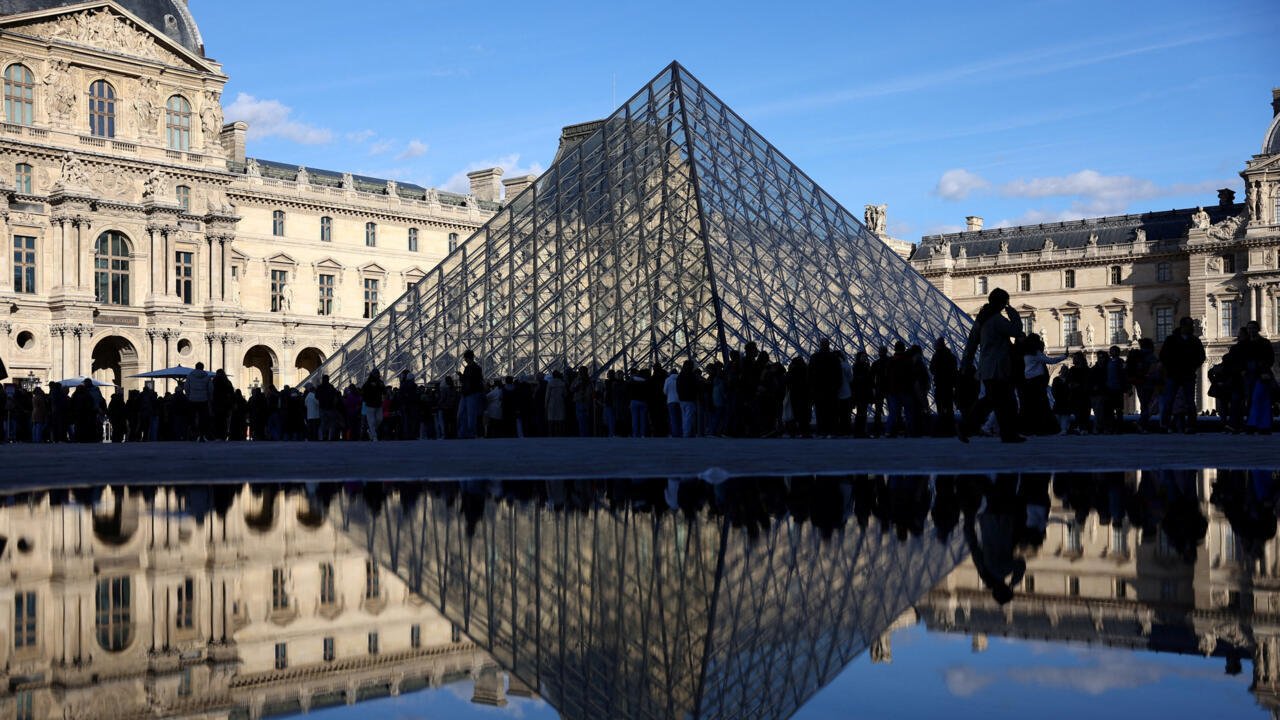
Why is the Louvre Increasing its Prices for Non-European Visitors?
A deteriorated financial situation
For several years now, the Louvre has been facing major structural challenges: an immense (73,000 m²) and aging building; significant renovation needs; a sharp rise in attendance requiring more human and technical resources; shortcomings revealed during the spectacular burglary of 19 October, during which Crown jewels were stolen, exposing the museum’s limited capacity to protect its collections; the Cour des comforts has recalled that the museum is facing “a wall of investments” it can no longer shoulder alone; this vast renovation project, supported by Emmanuel Macron, is estimated at more than one billion euros.
A measure driven by the government
To quickly bring in new financial resources, the government proposed a differentiated pricing structure between Europeans and non-Europeans, a measure approved on 27 November by the Louvre’s Board of Directors.
The announced financial objective:
An additional 15 to 20 million euros per year.
Money that should be directly reinvested in:
— The renovation of the museum
This is likely to considerably increase the workload of already understaffed teams.
This administrative constraint is far from insignificant:
— Verification of supporting documents
— Management of disputes and misunderstandings
— Slowing down of queues
The Cour des comptes had even explicitly pointed out that the proposed solution applying the highest price by default would require “a considerable number of checks.”
The Louvre is not an isolated case: a national movement underway
The Minister of Culture, Rachida Dati, confirms that this choice of differentiated pricing could extend to all major French cultural institutions.
Versailles may take the lead
The Palace of Versailles is already considering a 3-euro increase for visitors from outside the EEA, which could bring in more than 9.3 million euros per year.
The project still needs approval, but the movement appears well underway.
What about other museums?
The Musée d’Orsay indicates it does not plan any price increase for now.
But according to the minister’s statements, the entire public cultural sector will need to adapt to this approach in 2026.
Why specifically target non-European visitors?
A model already used in many countries
Differentiated pricing based on nationality exists in many countries:
— In Egypt, foreigners pay higher fees for archaeological sites.
— Most Asian museums offer residents reduced rates subsidised by the state.
— Some European countries offer preferential rates for local residents.
The French government believes this model can be applied to national museums.
Non-European visitors already spend more
According to international tourism trends:
— American and Chinese travellers have a higher average spending during stays in Europe.
— They allocate a significant share of their budget to cultural activities.
The increase, although substantial, is therefore expected to have limited impact on the overall volume of visits.
The cost of security
The cost of a high-quality visitor experience
Who will this increase apply to?
Visitors from outside the EEA
The 32-euro price applies to all visitors coming from outside:
— The European Union
— Iceland
— Liechtenstein
— Norway
This notably includes:
Americans, the museum’s largest foreign visitor segment
Chinese visitors, the third largest nationality at the museum
Canadians, Australians, post-Brexit British visitors, and other key groups contributing to the museum’s attendance
Worth noting:
The Louvre welcomed 8.7 million visitors in 2024, 69% of whom were foreigners meaning a very significant part of the audience is concerned by this measure.
A precedent: an increase already implemented in 2024
It should be remembered that the museum’s price had already risen recently.
In January 2024, the entrance fee increased from 17 to 22 euros for all visitors.
The 2026 increase establishes a fundamental break between European and non-European visitors something unprecedented in the museum’s history.
Why is this increase causing controversy?
- Unions denounce a break with the Louvre’s universalism
For unions (SUD, CGT, etc.), this differentiated pricing goes against the museum’s universal mission.
The Louvre has always been presented as a place of culture accessible to all, regardless of nationality.
An increase applying only to non-Europeans appears as a rupture of this principle.
The wording is strong:
“The destruction of two centuries of universalism” SUD
“A dilapidated museum funded by visitors who will pay the high price” CGT
- An additional workload for staff
Another issue: will the nationality or place of residence of visitors be checked?
Trade unions warn: the increase in the Louvre’s entrance fee for visitors from outside the European area reflects a profound shift in France’s cultural policy.
A necessary change, to fund the renovation and security of the world’s most visited museum but also one that raises debates about accessibility, cultural universalism, and the reception of international visitors.
In the coming years, it will be important to see whether this strategy will truly strengthen the museum… or whether it will instead create new tensions.
The Louvre remains a global symbol. The way it manages to combine funding, modernisation, and openness to all will be decisive for its future.